Making Money Personal
Engaging in real talk about financial matters that affect your life and your community.






Episodes

Aug 11, 2026
Aug 11, 2026
6 min
This month we’re joining in the call to raise awareness about the ongoing dangers of check fraud. Regardless of whether or not you still write paper checks, this information still matters because it is one of the many ways fraudsters are trying to steal money from unsuspecting victims.
Links:
View and download the One Page Guide on common types of check fraud
Learn more about the America Saves Pledge
Check out TCU University for financial education tips and resources!
Follow us on Facebook, Instagram and Twitter!
Learn more about Triangle Credit Union
Transcript:
Welcome to Money Tip Tuesday from the Making Money Personal podcast.
This week’s tip is a resource from the America Saves campaign presenting 5 specific types of check fraud to stay on guard against. This important awareness campaign is coordinated by the nonprofit Consumer Federation of America (CFA) which is dedicated to helping individuals save money, reduce debt, and build wealth. Take a moment, listen in, and share it with others so they can be made aware of this ongoing financial threat.
Let’s get into the 5 specific types of check fraud you should be aware of.
Even in a digital world, checks (paper or electronic) contain valuable information that criminals can use to steal money or commit fraud. At the same time, scammers are increasingly combining traditional check scams with electronic payments, mobile deposits, and peer-to-peer payment apps.
Understanding the most common types of check fraud can help you recognize warning signs and better protect your money.
1. Mail Theft
One of the most common ways check fraud begins is through stolen mail.
Criminals may target residential mailboxes, apartment mailrooms, or public collection boxes looking for outgoing checks such as rent payments, utility bills, or personal checks.
Once stolen, those checks may be altered, copied, or used to access personal banking information.
To reduce risk:
Drop mail inside the post office when possible
Avoid leaving outgoing checks in unsecured mailboxes overnight
Monitor expected payments and mail delivery closely
2. Check Washing
Check washing happens when a thief steals a completed check and removes the ink using chemicals. Once the original writing is removed, they rewrite the check with a new payee name or a larger amount.
For example, a $50 utility payment could become a $500 payment to a fraudster.
Even a small check can be changed into a much larger fraudulent payment.
Using permeant gel pens and avoiding blank spaces on checks may help reduce the risk of alteration.
3. Counterfeit Checks
Counterfeit checks are fake checks created using real bank account information. Scammers may use stolen logos and routing and account numbers to print checks that look legitimate. This can happen after mail theft or data theft.
Counterfeit checks may be used to make purchases, withdraw cash, or scam others.
Just because a check looks official does not mean it is legitimate.
4. Fake Check Scams
Fake check scams often begin with an unexpected opportunity or payment.
A scammer may:
Offer a fake job
Send a prize or lottery payment
“Overpay” for an online purchase
Send money for supplies or equipment
The victim is then instructed to deposit the check and quickly send some of the money back.
Many of these scams now involve electronic checks, mobile deposits, or peer-to-peer payment apps. A scammer may email a digital check image, ask someone to deposit it through a banking app, and then pressure them to send money electronically before the check fully clears.
Although funds may appear available in an account, the check can still later be rejected and could leave the victim responsible for the lost money.
Young adults, first-time workers, and online sellers are frequently targeted by these scams.
5. Forged Checks
Forged checks happen when someone signs or changes a check without permission.
This may include:
Signing another person’s name
Altering payment information
Changing endorsement details
Forgery can happen through stolen checkbooks, lost checks, or unauthorized access to financial information.
Monitoring your account regularly can help you spot suspicious activity sooner.
Why This Matters
Check fraud continues to evolve, and scammers are finding new ways to combine traditional check fraud with digital payment methods.
The good news is that awareness and simple habits can help reduce your risk.
Understanding how these scams work can help you:
Spot warning signs earlier
Avoid common scams
Protect your banking information
Take action quickly if something seems wrong
How to Protect Yourself
Monitor your accounts regularly
Set up banking alerts
Be cautious with unexpected checks or payments
Never send money back based on a deposited check alone
Use secure mail drop locations whenever possible
Learn More
Protecting your money starts with awareness. Download the helpful one-page guide that focuses on common types of check fraud, signs to watch for, and prevention tips. Link will be in the show notes.
Want to continue building your financial confidence through education? Follow the link in the show notes to take the America Saves Pledge today for tips, tools, and resources to help you save for what matters most to you.

Aug 4, 2026
Aug 4, 2026
7 min
How often do you reach for cash when making a purchase? If you are like most Americans, it’s not very often, and the bigger the purchase, the more likely you are to use a credit or debit card. Fraudsters are aware of these statistics so they develop tricky tactics to intercept your card information during the purchase process.
Links:
Check out the news story covering gluing: https://abc7news.com/glue-in-atm-slot-chase-scam-tap-card-bank/12935385/
Learn more about Triangle's Better Checking account with ID Protection
Check out TCU University for financial education tips and resources!
Follow us on Facebook, Instagram and Twitter!
Learn more about Triangle Credit Union
Transcript:
Welcome to Money Tip Tuesday from the Making Money Personal podcast.
Now, more than ever, it’s important to safeguard sensitive card information to prevent an interruption in your ability to make important purchases. It’s often stressed to pay attention to any attempts to steal our information when we use our cards online, but the unfortunate reality is that even if the card stays in your physical possession while paying, there are several ways that your card information can be stolen or used fraudulently. Let’s revisit two of these criminal practices, and learn how you can be your own superhero and stop fraud before it happens.
Skimming
You’ve probably heard about this one before. Skimming is a technique employed by criminals to steal sensitive payment card data, including credit or debit card numbers, PIN codes, and other personal information. Even though this illegal technique has been around for more than twenty years, it is still one of the most common types of card fraud. It typically occurs when a physical device, known as a skimmer, is placed on or near a legitimate card reader, such as an ATM or a point-of-sale (POS) terminal at a store or gas pump. The skimmer is designed to capture card data, while an additional component, like a hidden camera or keypad overlay, records PIN codes or other information about the payment card transaction.
Even if you have a chip card, many card terminals still use the magnetic stripe on the back of the card in addition to or instead of the chip. The only transactions that are not subject to skimmers are those where you do not insert your card past the chip portion, therefore, the magnetic stripe is not readable, or you use Tap-to-Pay. Tap-to-Pay allows a cardholder to physically tap the card on the device, which uses short-range wireless card reader technology to access the account, rather than relying on the physical attributes of the card.
How to Detect a Skimmer:
Examine the Card Reader Carefully: When using an ATM, or a POS terminal at a store or fuel pump, check the device for anything that looks odd. Fraudsters may attach a skimmer directly over the card slot or PIN pad, resulting in something that is not the same color or shape or looks bulky. Look for any other signs of tampering, such as scratches, glue residue, or a loose-fitting card slot (touch to see if it moves). If anything seems suspicious, avoid using the machine and report it immediately.
Use Your Hand to Shield Your PIN: You may have developed a habit of using your hand to shield the keypad when entering your PIN code if you are in line at the grocery store, but what about when you are alone at an ATM or gas pump? You need to include this as a habit every time you enter your PIN, no matter where you are. Criminals often install tiny miniature cameras at the point where a skimmer is installed to capture your PIN, as the skimmer captures the information from your card.
Use Secure and Trusted Devices: Whenever possible, use ATMs or payment terminals that are in well-lit, secure areas. When filling up, choose pumps close to and within sight of employees. Illegal skimmers must be installed by someone, and criminals will choose areas where they are the least likely to be noticed and caught.
Monitor Your Accounts Regularly: Regularly review your bank statements, credit card statements, and transaction history for any unauthorized or suspicious activity. Report any discrepancies to your financial institution immediately.
Gluing or "Glue-and-Tap"
Gluing or Glue-and-Tap is a method that criminals are using at ATMs to access your bank account directly, skipping the need for your card information altogether. This scam typically occurs at a free-standing ATM in a well-trafficked area where people approach on foot. It goes like this. The perpetrator pours glue into the card reader, setting up the scam. Sometime later you visit the ATM to retrieve cash, but you find that you can’t insert your card. A seemingly helpful bystander tells you that the machine is jammed, but if you tap your card, you can still make a withdrawal. At that point, you tap either your card (or phone), enter the PIN required for tap transactions, and leave, often even thanking the “helpful” stranger. The bystander is counting on you, the victim, not being familiar with this type of withdrawal and unaware that you will need to take an extra step to exit the account on the screen before leaving the ATM. Unlike when a card is inserted, and the account window closes when the card is removed, a tap transaction must be closed out on the screen. The criminal perpetrating this scam expects the victim to be unfamiliar with the process, and they can then drain the account that has been left open. Some victims even report being uncomfortable due to the bystander's presence; therefore, completing their transaction and being distracted in their effort to leave the area quickly and safely, leaving their account window open, even if they know better. Scammers utilized this method back in 2023 during a series of incidents in San Francisco, which was featured in a video news report.
To help protect yourself, avoid any ATM with a card reader that doesn’t seem to work properly. If you are comfortable using the tap feature on your phone or card for transactions, always wait for the prompt asking if you are finished and confirm that your account is no longer accessible before leaving.
It's up to all of us to stay protected against identity theft, particularly in the case of payment card fraud. But if a criminal gets your payment card, they may not stop there. If you feel you may be a victim of identity theft, we have professionals standing by to help you get your life back on track. If you have a Better Checking account at Triangle, take a moment to review and activate your monitoring benefits. This will help you stay informed of any activity that could indicate you are a victim of identity theft.
If there are any other tips or topics you'd like us to cover, let us know at tcupodcast@trianglecu.org. Also, remember to like and follow our Making Money Personal Facebook and Instagram to share your thoughts. Finally, remember to look for our sponsor, Triangle Credit Union, on Facebook and LinkedIn.
Thanks for listening to today's Money Tip Tuesday. Check out our other tips and episodes on the Making Money Personal podcast.

Jul 28, 2026
Jul 28, 2026
4 min
Managing your money should feel simple, not stressful. With the right accounts and smart financial tools, reaching your goals and staying in control of your finances has never been easier. That’s why we created the Smart Money Bundle—a convenient solution designed to help you make the most of your money.
Links:
Check out Triangle's Smart Money Bundle for a smarter way to save
Learn more about Triangle's no minimum balance, Better & Basic Checking account options
Learn more about our Direct Deposit Drawing and the chance to win $750! Enter the drawing by October 4, 2026. See Official Rules for additional details.
Download our Direct Deposit Form to start setting up your first direct deposit.
Learn more about our higher-than-average tiered rates Online Savings account to jump start savings.
Learn more about our Goal Builder tool to set up and automate savings goals.
Check out TCU University for financial education tips and resources!
Follow us on Facebook, Instagram and Twitter!
Learn more about Triangle Credit Union
Transcript:
Welcome to Money Tip Tuesday from the Making Money Personal podcast.
The sun is shining, children are out of school for the summer, and you may be planning to (or have already scheduled to) take time off from work for vacation; this is the time of the year when you want to sit back and relax while enjoying the nice weather with friends and family. But something that should never take a back seat is your finances because your financial situation is important and your future matters.
Looking for a simple way to stay on top of your finances? With the right combination of accounts and services, you can make everyday banking easier while building toward your savings goals. With Triangle’s Smart Money Bundle, you can improve your finances and create your own financial goals. Here’s how to take advantage of bundle:
1. Open a No Minimum Balance Checking Account
You don't need a hefty minimum balance in checking anymore-- you just need enough to cover the transactions! Avoid the penalty of low minimum balances on your checking with one of our great checking account options. Better Checking Account with Identity Protection* or Basic Checking Account. Both of these checking accounts come with a contactless debit card, so for more security and convenience, add it to your digital wallet and get on with your summer adventures.
2. Set Up Direct Deposit with Early Paycheck
Did you know that you could receive your paycheck up to two days early with ACH approval from your employer if you set up direct deposit? Plus, for a limited time we’re running a special drawing you don’t want to miss! From now until October 4th 2026, when you set up a new direct deposit, you’ll be entered into a drawing for your chance to win $750*. *There’s no purchase necessary so visit triangleuniversity.org/contests/ or follow the link in the show notes for full drawing rules.
If you’ve been putting off setting up a direct deposit for a while now, don’t miss this chance. It’s the perfect time to get started and super easy with our simple direct deposit form . Access the form directly using the link in the show notes.
3. Open an Online Savings and Begin Saving with Goal Builder Your funds are easily accessible and available for online transfers with a Premium Online Savings account.
This savings account has higher-than-average tiered rates and there is no minimum deposit required to open, no limits to deposit, and no limits to withdraw funds thereafter.
After opening your online savings account, begin saving towards the goals that matter most to you with Goal Builder. Goal Builder is our online banking tool that helps you save towards your financial goals, automatically so you can take the stress and guess work out of saving.
Triangle’s Smart Money Bundle was designed to highlight three financial products and services that when utilized together, can simplify your financial journey. Visit Smart Money Bundle - Triangle Credit Union to learn more about the Smart Money Bundle and get started today!

Jul 21, 2026
Jul 21, 2026
6 min
Looking after your financial health matters just as much as caring for your physical health. Just as you track health stats to see what needs attention, you should also keep an eye on your money, check your progress, and see what needs improvement. Fortunately, tracking a few key areas can paint a good picture of your overall financial health and illuminate areas that may need improvement.
Links:
Learn more about Triangle's Financial Planning services
Get a snapshot of your financial health with our free Financial Wellness Assessment
Check out TCU University for financial education tips and resources!
Follow us on Facebook, Instagram and Twitter!
Learn more about Triangle Credit Union
Transcript:
Welcome to Money Tip Tuesday from the Making Money Personal podcast.
We all learn early on that taking care of our health is essential. We’re told to eat well, exercise, and manage stress. Looking after our bodies helps us stay strong and ready for life’s challenges. The same goes for financial health. It means checking your finances, keeping an eye on your spending, and tracking your progress to build a solid plan for the future.
The good news is that keeping track of your financial health isn’t hard. With a simple plan, you can review your situation, set goals, and take steps toward stable finances. Begin by looking at these main financial areas to gather the right information and get a clear view of where you stand.
Savings Strategy & Habits
In this area, you keep track of your current savings and see how well you’re saving. Checking your savings habits and balances shows how ready you are to handle surprises or a loss of income.
It’s important to look at how often you save, the total amount you’ve saved in different accounts, and your household income.
Track your total savings in checking, high-yield savings, and brokerage accounts. Also, note any automatic savings contributions and interest earned on your savings.
Cash & Liquidity Health
This shows how steady your cash flow is. The money coming in should cover your needs and help you plan for your wants. Available cash gives you flexibility, and liquid cash is money you haven’t spent yet.
However, debt can make things harder. Debt affects your ability to access cash. If your payments stay below your income, you’re okay. But if your debt grows too much, it can limit your cash flow and make your finances less flexible.
In this section, review your cash flow, see if you can pay for your needs and wants, and compare your income to your debts.
You’ll want to track your income, total debt, debt-to-income ratio, and interest rates you’re paying to measure your cash and liquidity health.
Investments Health
This area is about long-term planning. Think about what you want your life to look like after you retire, how much money you’ll need, and whether your savings will support your post-retirement lifestyle.
Keep in mind that your investment needs will change as you get closer to retirement, so it’s a good idea to review your investments regularly. Financial professionals can help you choose the right mix for your stage of life and guide you in building a portfolio that fits your retirement plans. For more help, visit Triangle’s financial planning services at trianglecu.org or use the link in the show notes.
Track your current retirement savings, how much you’re contributing, your projected retirement savings and income, and what you expect to spend in retirement. Put all this information into a retirement plan that you can update as your situation changes.
Protection Health
Protecting yourself and your finances is an important part of staying healthy overall. This is a way to prevent problems before they happen. Just as health insurance helps with medical costs, life and disability insurance can help if something major affects your finances.
Long-term planning helps protect your wealth from unexpected problems. It also shields your loved ones and yourself from financial stress if something goes wrong.
Think about what insurance you have besides your employer’s life insurance. Do you also have an additional life insurance policy, short- or long-term disability, or, for later in life, long-term care insurance?
Check which insurance policies you have, how much coverage they offer, and if that’s enough to support you financially when needed. Review your premiums, coverage amounts, and look for any gaps in coverage you might need to fill.
Estate & Legacy Health
Estate planning is about preparing for what happens after you’re gone. Many people don’t have a plan and leave their families with a lot to sort out. Avoid this by making a clear, organized estate plan. This lets you decide how your assets, like your home and accounts, will be passed down according to your wishes.
There’s a lot to think about here, so when it comes to estate planning, it’s also important to have a financial professional right by your side to walk you through the ins and outs of putting together a solid financial plan. If you’re looking for help or services in this area our professionals help with this too. Follow the link in the show notes for our financial planning services.
If you've collected all the information but don’t know whether it means yore in good financial health or not, you can get a personalized report fast with our quick and easy personal financial assessment. It asks a few questions, gives you a personalized report, and then highlights your areas for improvement. It only takes a few minutes and is a great first step toward understanding and improving your finances. Start today for a clearer view of your financial health. Try it out today! Visit trianglecu.org or follow the link in the show notes to get started.
If there are any other tips or topics you'd like us to cover, let us know at tcupodcast@trianglecu.org. Also, remember to like and follow our Making Money Personal Facebook and Instagram to share your thoughts. Finally, remember to look for our sponsor, Triangle Credit Union, on Facebook and LinkedIn.
Thanks for listening to today's Money Tip Tuesday. Check out our other tips and episodes on the Making Money Personal podcast.

Jul 14, 2026
Jul 14, 2026
6 min
Buying a home is one of the biggest financial decisions you'll ever make. If you are not ready to buy yet because mortgage rates feel high, your down payment needs more time, or the right house has not hit the market; the waiting period can still work in your favor. Don’t let the home buying delay get you down. Instead, let it motivate you to work towards a more favorable purchase outcome.
Links:
Listen to our past episode "What the Heck is Credit and Why is it Important?" to learn more about credit scores and reports
Check out TCU University for financial education tips and resources!
Follow us on Facebook, Instagram and Twitter!
Learn more about Triangle Credit Union
Transcript:
Welcome to Money Tip Tuesday from the Making Money Personal podcast.
Finding the right house can be challenging. For many buyers, it’s a process that’s hard to predict and in many cases, can take longer than expected. The good news is that the waiting period doesn't have to be wasted time. In fact, a few smart financial moves now can put you in a much stronger position when it's finally time to make that offer.
If you’re one of the many people waiting to find the right house to call home, here are a few things you can do in the meantime to get your financial situation in tip top shape while waiting.
1. Build a Bigger Down Payment
One of the most productive things you can do while waiting to buy is continue growing your down payment fund.
A larger down payment can reduce your monthly mortgage payment, lower the amount you'll need to borrow, and potentially help you avoid private mortgage insurance (PMI). Even adding a few extra thousand dollars to your savings can make a meaningful difference over the life of the loan.
Consider setting up automatic transfers into a dedicated high-yield savings account, so your home fund continues to grow without requiring constant attention.
2. Improve Your Credit Score
Your credit score plays a major role in calculating the mortgage rate you'll qualify for. Even a small improvement could save you thousands of dollars over the life of a loan. This waiting period is a great time to beef up that score for a better purchase position.
While you're waiting, focus on:
Paying bills on time
Reducing existing credit card balances
Avoiding new debt
Reviewing your credit report for errors
Think of this period as an opportunity to strengthen your financial profile before mortgage lenders take a closer look.
3. Pay Down Existing Debt
Lenders pay close attention to your debt-to-income (DTI) ratio when evaluating mortgage applications. The lower your monthly debt obligations, the more attractive you may appear as a borrower. Take some time to do the math and figure out what your debt-to-income ratio is. If it’s uncomfortably high, make some changes.
Reducing debt can improve both your borrowing power and your overall financial flexibility once you become a homeowner.
For more information about credit scores in general, listen to one of our podcast episodes “What the Heck is Credit and Why is it Important” for an expert explanation on building and maintaining a good credit score. Check the link in the show notes.
4. Build an Emergency Fund
It's easy to focus entirely on saving a down payment, but homeownership comes with unexpected expenses. Water heaters fail, roofs leak, and appliances don't always cooperate.
Before buying, aim to have an emergency fund that can cover several months of living expenses. Having cash reserves can help prevent a surprise repair from turning into a financial setback.
5. Research Your Future Neighborhoods
The waiting period can also be a great time to become a more informed buyer. Doing preliminary work and research is always a good idea, because it helps you further solidify where you really want to live. This is important because it’ll decrease the chance of buying a home so abruptly that you didn’t get a chance to consider the location. So, you put in the offer, signed the contract and finally moved in only to realize you hate the neighborhood. These days things move quickly, so having a firm understanding on locations can help you rest easy knowing you're making the right move when you buy.
Spend time researching things like:
School districts
Property taxes
Commute times
Local amenities
Future development plans
Environmental factors – human-caused (like contaminated water or natural like flooding risk)
While researching, visit neighborhoods at different times of day and on weekends. What looks perfect during a Sunday afternoon visit may feel very different during a weekday rush hour.
6. Create a Realistic Homeownership Budget
Many buyers focus primarily on the mortgage payment, but that's only part of the equation. Homeownership brings with it many added costs. Take some time, do research and develop a budget that will include not only the mortgage but added payments you can expect to make down the road including:
Property taxes
Homeowners insurance
Utilities
Maintenance and repairs
HOA fees, if applicable
A useful exercise is to "practice" the future payment. If your current rent is $1,800 and you expect a future housing payment of $2,500, try setting aside the extra $700 each month. This can help you test your budget while increasing your savings.
7. Avoid Major Financial Changes
If you expect buying within the next year, it's wise to avoid actions that could complicate a future mortgage application.
Be wary and try to avoid changes that can disrupt your financials like:
Taking on large amounts of new debt
Financing expensive purchases
Frequently opening new credit accounts
Making large unexplained bank deposits
Consistency and stability often work in your favor during the mortgage approval process.
Waiting to buy a house can feel frustrating, especially when you're eager to move into a place of your own. But the time before your purchase can be one of the most valuable parts of the homebuying journey.
By strengthening your savings, improving your credit, reducing debt, and preparing for the realities of homeownership, you'll be positioning yourself for a smoother purchase and a stronger financial future. When the right house finally comes along, you'll be ready to move forward with confidence.
If there are any other tips or topics you'd like us to cover, let us know at tcupodcast@trianglecu.org. Also, remember to like and follow our Making Money Personal Facebook and Instagram to share your thoughts. Finally, remember to look for our sponsor, Triangle Credit Union, on Facebook and LinkedIn.
Thanks for listening to today's Money Tip Tuesday. Check out our other tips and episodes on the Making Money Personal podcast.

Jul 7, 2026
Jul 7, 2026
4 min
We’ve all been there—you open an email and something just doesn’t feel right. Maybe it’s an unexpected attachment, a link asking you to “act fast,” or a message that looks like it came from a coworker but sounds off.
Knowing how to spot a suspicious email is important. But what really makes the difference is how you respond. A quick, thoughtful reaction can stop a potential issue in its tracks, while the wrong move can accidentally make things worse.
Links:
Learn more about KnowBe4 fraud awareness and training tools
Check out TCU University for financial education tips and resources!
Follow us on Facebook, Instagram and Twitter!
Learn more about Triangle Credit Union
Transcript:
Welcome to Money Tip Tuesday from the Making Money Personal Podcast.
This tip comes from an article provided by KnowBe4 security Awareness and Training Solutions.
First of all, let's look at what you should not do with a suspicious email. You should not respond to it. It’s natural to want to confirm legitimacy, especially if the message appears to come from someone you know. But if the account has been compromised, you’re not talking to your friend or coworker—you’re talking to a scammer. Even a simple reply signals that your email is active and monitored, which can make you a bigger target going forward. Instead, verify through another channel if needed, like a direct phone call or a fresh email you initiate.
Secondly, don't click any links or attachments. Suspicious emails often include links that redirect to fake login pages to get your credentials or attachments that download malware. Sometimes the signs are subtle. You might click expecting a document, only to get a login request or a strange pop-up instead. If anything behaves unexpectedly, stop immediately. That’s a red flag.
If you receive a suspicious email, don't forward it to others. When something doesn’t look right, it’s tempting to ask someone else for a second opinion. But forwarding a suspicious email spreads potential risk. If it’s malicious, you’ve just exposed someone else to the same threat and increased the chances that someone clicks.
Now that we've gone over what not to do, here's what you should do with a suspicious email. You should report it right away. The most important step is also the simplest: report the email using the email service's report option or if you are at work, your organization’s security tools. Once you've reported it, leave it alone. Don't click it, don't reply, and don't download it.
If you're unsure if the email is malicious, it is best practice to ignore it. If you receive an email at work that you are unsure of, reach out to your organization's IT team. It’s always better to ask than guess. There’s no downside to being cautious.
Trust your instincts when it comes to spotting suspicious emails. Watch out for common warning signs such as urgent messaging, like language pressuring you to act now. Other warning signs include unusual requests such as asking for login credentials or gift cards and inconsistencies in the email like typos or odd formatting.
In a fast-paced day, it’s easy to click first and think later. But when it comes to email security, a few seconds of pause can save you a lot of trouble. No need to overanalyze or investigate on your own. Just avoid the common pitfalls, follow the process, and let the experts take it from there. Staying secure is about being aware, cautious, and consistent.
If there are any other tips or topics you'd like us to cover, let us know at tcupodcast@trianglecu.org. Also, remember to like and follow our Making Money Personal Facebook and Instagram to share your thoughts. Finally, remember to look for our sponsor, Triangle Credit Union, on Facebook and LinkedIn.
Thanks for listening to today's Money Tip Tuesday. Check out our other tips and episodes on the Making Money Personal podcast.
Jul 2, 2026
Jul 2, 2026
35 min
The college funding space is always changing which can create new challenges for students and parents as they venture forward with their higher education planning. In this episode, Micha Sabovik, Vice President, Growth & Lending Solutions at Granite Edvance, shares important updates on what's new in the student lending space, upcoming changes to be aware of and strategies students and parents can follow to choose the right funding for their higher education.
Links:
Access free resources, book one-on-one appointments, and find links to helpful tools and guides: https://graniteedvance.org/plan-your-journey/get-our-help/
Explore financial aid resources: https://graniteedvance.org/find-your-direction/resource-library/
Check out Granite Edvance's YouTube Channel: https://www.youtube.com/@GraniteEdvance
Get official FAFSA forms and helpful wizards to determine dependency status and required contributors: https://studentaid.gov/
Check out TCU University for financial education tips and resources: https://triangleuniversity.org/
Learn more about Triangle Credit Union: https://www.trianglecu.org/
Update: The topic of changes to the federal direct loan program related to professional degrees was discussed on this podcast; since the recording, the effective date of these changes has been put on indefinite hold pending the outcome of certain litigation that is referenced in the podcast. Depending on the outcome of that litigation, these program changes may differ from the description on the podcast or could be struck down altogether.
Disclaimer: The views, thoughts, and opinions expressed are the speaker’s own and do not represent the views, thoughts, and opinions of Granite Edvance. The material and information presented here is for general information purposes only and is believed to be materially accurate at the time of this recording; however, information presented is subject to change without notice and should not be construed as a commitment by Granite Edvance. For current information about our products and services, please see our website at graniteedvance.org.

Jun 30, 2026
Jun 30, 2026
5 min
As the United States approaches its 250th birthday, it’s a meaningful time to reflect on independence—and how it shows up in everyday life. Beyond the national celebration, this milestone is also an opportunity to take one practical step toward greater financial confidence, flexibility, and peace of mind.
Links:
Download our $250 Stars Stripes and Savings Challenge Tracker to start saving now!
Stars, Stripes & Savings - $5 Increment Tracker
Stars, Stripes & Savings - $10 Increment Tracker
Check out TCU University for financial education tips and resources!
Follow us on Facebook, Instagram and Twitter!
Learn more about Triangle Credit Union
Transcript:
Welcome to Money Tip Tuesday from the Making Money Personal podcast.
Financial independence does not have to mean retiring early or reaching one perfect number. For many people, it starts with having breathing room: savings for the unexpected, less reliance on high-interest debt, and more choices when life changes. This year, celebrate freedom by building habits that help you feel more prepared for the future.
What Is Financial Independence?
At its core, financial independence means having enough savings, income, and/or investments to support your needs without relying entirely on your next paycheck. It does not necessarily mean never working again. Instead, it means having more room to make choices that fit your life.
That goal looks different for everyone. For some, it may mean building an emergency fund or paying down debt. For others, it may mean preparing for a career change, taking time off, or supporting a loved one without added financial strain. No matter your starting point, the goal is the same: more stability, confidence, and peace of mind.
Why Financial Independence Matters
Just as our nation’s independence allows us to shape our future, financial independence gives you the ability to shape yours. It does so in a few specific ways.
It Reflects the Spirit of Freedom
A strong savings habit can help you become less dependent on circumstances beyond your control. It supports the same values often associated with independence: preparation, resilience, and the ability to move forward with confidence.
It Reduces Financial Stress
Unexpected expenses are part of life. Having savings and a plan in place can ease anxiety and help you navigate challenges with more preparation and less stress.
It Expands Your Opportunities
When your finances are in a strong position, doors open. You may find yourself able to:
Explore new career paths
Start a business
Spend more time with loved ones
Invest in experiences that matter most
It Builds Long-Term Security
A financial cushion can help protect you from job changes, rising costs, emergency repairs, or medical expenses. Even a modest amount saved can provide stability when the unexpected happens.
How to Begin Your Journey
Starting your path to financial independence does not have to feel overwhelming. Consider beginning with a few simple steps:
Define your goal. Decide what financial independence means for you right now, such as saving for emergencies, reducing debt, or feeling more in control of monthly expenses.
Build a starter safety net. Set a realistic first savings target and work toward it consistently. Some make this their first $5,000, some $1,000, and for others it may be closer to $500. Whatever you choose, make sure it’s realistic for your personal situation right now.
Automate your progress. Consider recurring transfers or direct deposit so saving becomes part of your routine.
Reduce high-interest debt. Paying down costly balances can free up money for future goals.
Track and celebrate milestones. Small wins help build momentum and keep your goal visible.
Stars, Stripes & Savings: $250 Independence Challenge
One simple way to begin is with our Stars, Stripes & Savings $250 Challenge. In honor of America’s 250th birthday, this challenge breaks a $250 savings goal into small manageable steps of just a few dollars each. There are two challenges to pick from. One is set up for twenty-five, $10 increments, great for adults, while the other is set up for fifty, $5 increments, perfect for kids!
This year, as the country celebrates 250 years of independence, use the moment to establish your own financial independence day. Start small, stay consistent, and let each step create more confidence in your future.
Download the Stars, Stripes & Savings Independence Day Challenge tracker and start today. Save your first $5 or $10, mark your first star, and build momentum one step at a time! Feeling gutsy, try doing both to save $500 total. Share the challenge with family and friends, track your progress, and celebrate each milestone along the way.
If there are any other tips or topics you'd like us to cover, let us know at tcupodcast@trianglecu.org. Also, remember to like and follow our Making Money Personal Facebook and Instagram to share your thoughts. Finally, remember to look for our sponsor, Triangle Credit Union, on Facebook and LinkedIn.
Thanks for listening to today's Money Tip Tuesday. Check out our other tips and episodes on the Making Money Personal podcast.

Jun 23, 2026
Jun 23, 2026
6 min
Summer is an exciting time, and for many, the perfect time to get out and do some traveling. While you're enjoying the fun of planning, searching, and packing, remember that identity thieves and scammers are still out there plotting ways to trip you up and gain access to your personal information.
Links:
Learn more about the identity protection benefits with a Better Checking account
Check out TCU University for financial education tips and resources!
Follow us on Facebook, Instagram and Twitter!
Learn more about Triangle Credit Union
Transcript:
Welcome to Money Tip Tuesday from the Making Money Personal podcast.
Summer travel season is upon us, and it can come with a lot of excitement and a lot of distractions. That’s exactly when people slip up with their personal information without realizing it. A few simple habits can make a big difference in keeping your identity safe while you’re preparing to head out on the road. Don’t let identity thieves ruin your summer plans. Before you pack, post, or travel, review these guidelines to help protect your identity against scammers and identity thieves.
Be careful what you share online
It’s easy to overshare without meaning to. Posting your travel plans gives scammers more information than you think. Be mindful of what you share on social media. Sharing details like birthdays, travel plans, or even pet names can give scammers the clues they need to guess passwords or impersonate you. A few extra seconds of caution can help protect your accounts and your identity. Even a photo of a boarding pass can expose details someone can use to get into your accounts. Share the moment, not the specifics.
Avoid logging into sensitive accounts on public Wi‑Fi
Airports, hotels, and coffee shops are convenient, but the Wi‑Fi is often wide open. Open networks are convenient, but they’re also easier for criminals to intercept. Anyone on the same network can try to snoop. If you need to check something important (banking, email, anything with personal information), use your phone’s hotspot or wait until you’re on a secure connection.
Keep your devices locked down
Travel days can be chaotic. Phones get left on seats, laptops get forgotten at security, and backpacks get unzipped without anyone noticing. A strong passcode, a biometric (face or fingerprint) lock, and “find my device” turned on can save you a lot of stress if something goes missing.
Watch out for “urgent” messages
Travelers have been known to get fake vacation deals, fake airline alerts, fake hotel confirmations, and fake texts about “suspicious activity.” If a message pressures you to “act now” or “click immediately,” or threatens that your account will be closed or reservation will be cancelled, pause and take a moment before you take action. Go directly to the official website or app instead of engaging with these “urgent” messages. And remember, Triangle Credit Union will never pressure you with “urgent” messages demanding immediate action.
Don’t carry every document with you
When you’re traveling, leave things like your Social Security card, passport (unless you need it), and birth certificate at home. The fewer important documents you have on you, the less you can lose.
Shred anything with personal details
Travel planning can often bring a pile of mail filled with offers, pre-approvals, and random “welcome” packets. As you evaluate what to keep and what to discard, remember that anything with your name, address, or financial information should be shredded before you add it to the recycling or trash can. It sounds small, but dumpster diving for personal information is still a thing.
Use strong, unique passwords
If you’re new to traveling, you’re probably creating new accounts. Use passwords that are long, unique, and hard to guess; think of a mix of letters, numbers, and symbols rather than personal details like birthdays or names. At the same time, avoid recycling the same password across multiple accounts. Taking a few minutes to strengthen your passwords today can help protect your accounts from fraud tomorrow.
Check your accounts regularly
A quick weekly look at your bank accounts, credit card activity, and email security settings can help you catch something early. Many times, identity theft starts with tiny, easy‑to‑miss charges. Reviewing your accounts on a routine basis is one of the strongest defenses against identity theft. Spotting unfamiliar charges or changes early allows you to act quickly and limit potential damage.
Be mindful with travel documents
Don’t leave boarding passes, hotel key sleeves, or rental car paperwork lying around. They often contain barcodes or account numbers that can be scanned or photographed. Lost or stolen travel documents can give fraudsters the information they need to open accounts or impersonate you, so a little extra care can go a long way to help protect your identity.
Summer travel should feel fun, not stressful. A few small habits can help you keep your identity safe while you enjoy the moment. But even when you do everything right, identity theft can still strike. If you suspect you’re a victim, contact us - even if it’s not related to your account at Triangle. Remember that if you have a Better Checking account, it comes with access to a professional, certified Identity Theft Recovery Advocate who can work with you one-on-one to identify and resolve identity theft or fraud and return your identity and your accounts to pre-event status. Visit trianglecu.org today to learn about the protective benefits of a Better Checking or use the link in the show notes.
If there are any other tips or topics you'd like us to cover, let us know at tcupodcast@trianglecu.org. Also, remember to like and follow our Making Money Personal Facebook and Instagram to share your thoughts. Finally, remember to look for our sponsor, Triangle Credit Union, on Facebook and LinkedIn.
Thanks for listening to today's Money Tip Tuesday. Check out our other tips and episodes on the Making Money Personal podcast.

Jun 16, 2026
Jun 16, 2026
5 min
What if saving money didn’t require giving up the things you enjoy—but simply changing how you manage what you already earn? The truth is, small, intentional habits can quietly build significant wealth over time. By putting the right systems in place, you can make saving feel effortless instead of overwhelming.
Links:
Track your savings goals with Goal Builder
Explore some other saving challenges to make saving fun
Check out TCU University for financial education tips and resources!
Follow us on Facebook, Instagram and Twitter!
Learn more about Triangle Credit Union
Transcript:
Welcome to Money Tip Tuesday from the Making Money Personal podcast.
Saving money doesn’t have to feel restrictive. With the right strategies you can steadily build financial security without drastically changing your lifestyle. Whether you're just getting started or looking to improve your current habits, these 5 practical approaches can help you save more efficiently and consistently.
Number 1: Automate savings with direct deposit.
One of the simplest and most effective ways to save money is to remove the need for decision-making altogether. Automating your savings ensures that a portion of your income is set aside before you have the chance to spend it.
Many employers allow you to split your direct deposit into multiple accounts. By directing a percentage of each paycheck into a dedicated savings account, you create a "pay yourself first" system. This method builds savings effortlessly and reduces the temptation to spend.
Even small automated contributions of 5-10% or $25-$50 a paycheck can add up significantly over time, especially when paired with interest-earning accounts.
Number 2: Set up a savings goal tracker.
Having a clear savings goal gives your efforts purpose and direction. Whether you're saving for an emergency fund, a vacation, or a large purchase, tracking your progress helps you stay motivated.
A savings tracker can be as simple as a spreadsheet, mobile app, or visual chart. For more sophisticated tracking try an online banking tool like Triangle’s Goal Builder tool within online and mobile banking. Seeing your progress grow over time reinforces positive financial behavior and keeps you accountable.
To make tracking more fun, break your larger goals into smaller milestones. For example, instead of focusing on saving $10,000, focus on and celebrate reaching every $1,000 mark. These smaller wins make the process feel achievable and rewarding.
Number 3: Try a savings challenge.
Savings challenges are a fun and structured way to build momentum. They turn saving into a game, making it more engaging and less of a chore.
Popular challenges include:
The 52-week challenge, where you gradually increase your savings each week or save a certain amount of money each week for a whole year
The no-spend challenge, where you limit discretionary purchases for a set period
The round-up method, where purchases are rounded up and the difference is saved
The 100-envelope challenge, where you save a specified dollar amount in every envelope until they’re all filled
These challenges not only boost your savings but also increase awareness of your spending habits. Over time, they can help you develop long-term discipline and smarter financial choices.
For more ideas on additional savings challenges visit triangleuniversity.org or follow the link in the show notes.
Number 4: Seek out high-yield savings accounts.
Not all savings accounts are created equal. Traditional accounts often offer minimal interest, while high-yield savings accounts provide significantly better returns.
By keeping your money in a high-yield account, you allow your savings to grow passively through compound interest. Even modest interest rates can make a noticeable difference over time, especially with consistent contributions.
When comparing accounts, consider:
Interest rates (APY)
Fees
Minimum balance requirements to open the account or earn interest
Ease of access
Choosing the right high-yield savings account ensures your money is working as hard as you do.
Number 5: Make use of employer benefits like FSAs and HSAs.
Employer-sponsored benefits such as Flexible Spending Accounts (FSAs) and Health Savings Accounts (HSAs) can be powerful tools for saving money, particularly on healthcare expenses.
These accounts allow you to set aside pre-tax income, effectively reducing your taxable income and increasing your take-home value. HSAs, in particular, offer long-term advantages since unused funds can roll over year after year and even be invested.
By planning for expected medical costs using these accounts, you can avoid dipping into your regular savings and maximize your financial efficiency.
Saving money effectively isn’t about making drastic sacrifices—it’s about building smart, sustainable habits. By automating your savings, tracking goals, engaging in challenges, maximizing interest, and leveraging available benefits, you can steadily grow your financial security.
Start small, stay consistent, and remember: every dollar saved is a step closer to your financial goals.
If there are any other tips or topics you'd like us to cover, let us know at tcupodcast@trianglecu.org. Also, remember to like and follow our Making Money Personal Facebook and Instagram to share your thoughts. Finally, remember to look for our sponsor, Triangle Credit Union, on Facebook and LinkedIn.
Thanks for listening to today's Money Tip Tuesday. Check out our other tips and episodes on the Making Money Personal podcast.
Financial Lessons & Tips
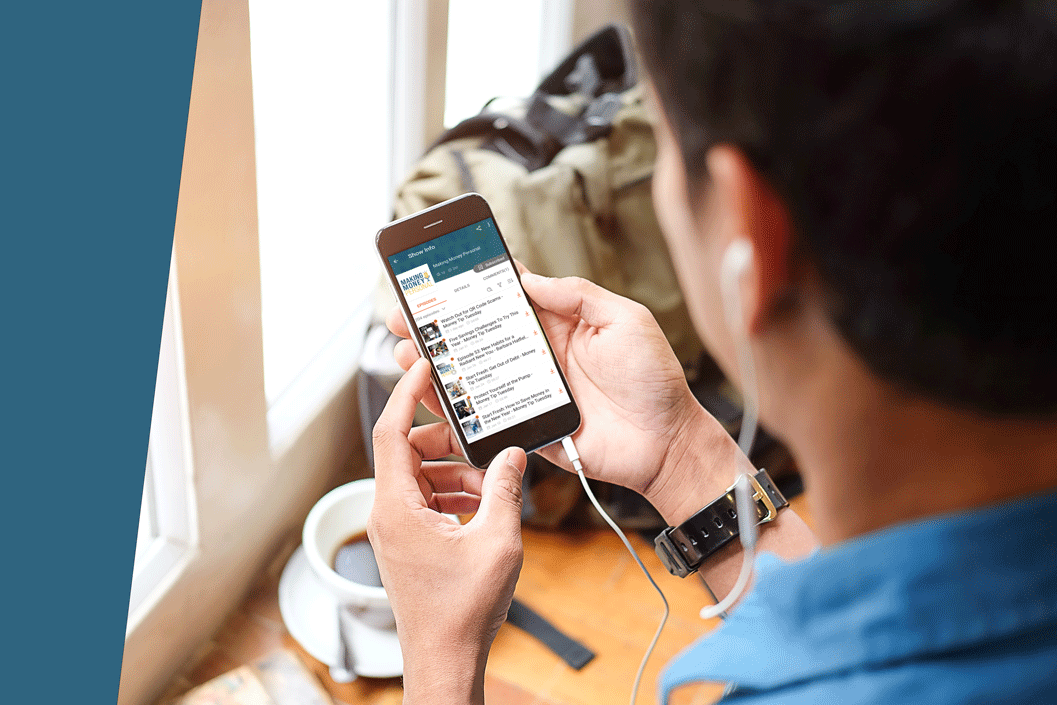
Join us for fun, relevant financial topics that provide you with resources to help you make financial decisions. The Making Money Personal Podcast talks about the impact that money has on your personal and professional life. Our podcast examines trends and topics with support from industry professionals.